 Ask Bookie
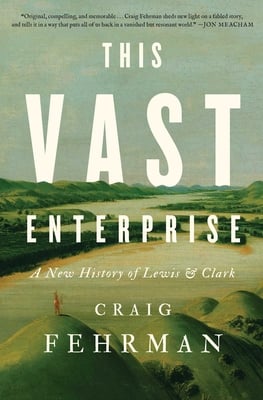
This Vast Enterprise : A New History of Lewis & Clark

Other Available Formats
Overview
NEW YORK TIMES BESTSELLER - A major revisionist history of the Lewis and Clark expedition: For the first time in a generation, This Vast Enterprise offers a fresh and more accurate account of one of the most important episodes in American history, humanizing forgotten figures and shattering long-held myths. "This Vast Enterprise is a page-turner and a fantastic achievement." --The New York Times - "Immensely engaging." --The Wall Street Journal - "This is vivid, character-based history...It also makes for a ripping good read." --The Boston Globe "Do we really need another book about the Lewis and Clark expedition?...My answer is an emphatic yes. The author has done a huge amount of research, shifting the focus away from the familiar pairing of Meriwether Lewis and William Clark...Each chapter unfolds from the viewpoint of a different individual and the result is a richly woven tapestry of voices...Fehrman reframes this well-known story, revealing it as more complex, and profoundly human." --Andrea Wulf, The New York Times Book Review (front-cover review) In 1806, when Meriwether Lewis and William Clark return from their journey--having led the Corps of Discovery across eight thousand miles of rapids, mountains, forests, and ravines--they bring an incredible tale starring themselves as courageous explorers, skilled survivalists, underrated scientists, and peaceful ambassadors. While there is truth in those descriptions, there is also distortion. From one of the most exciting new historians to emerge in the past decade, This Vast Enterprise offers a novel take on the expedition: a gripping narrative that draws on lost documents, stunning analysis, and Native perspectives. Craig Fehrman spent five years visiting more than thirty archives, interviewing more than a hundred sources, and collecting oral history passed down over centuries. He came to see that the success of Lewis and Clark depended on much more than just Lewis and Clark. We all know Sacajawea, and some of us know York, the Black man Clark enslaved. But here we meet John Ordway, a working-class soldier who fought grizzlies and towed the captains' hulking barge. We hear from Wolf Calf, a Blackfoot teenager who watched his friend die in a battle with Lewis and his men. Each chapter moves to a different person's point of view, describing their desires and contradictions. We see Thomas Jefferson operating in an age of bitter partisan unrest--his secret political maneuvers to fund the expedition, revealed here for the first time, are a case study in presidential power. We witness the strategy and strength of Black Buffalo, completely upending our understanding of Lakota-American diplomacy. York, in his chapters, finds ways to wield power and make choices in an era that didn't allow him much of either. Clark is not a folksy Kentuckian but a student of the Enlightenment. (Fehrman discovered his college notebook; no previous biographer even realized that he went to college.) Lewis is someone willing to sacrifice everything for his country and his mentor, Jefferson. In the end, the captains are men who needed help--from Sacajawea, from the Corps, and from each other. Mile after mile, the expedition pushes on through hailstorms and flash floods, frostbite and infections, rattlesnakes and rabid wolves, with the Spanish cavalry in fierce pursuit. Fehrman balances the story's adventure with the humanity of its protagonists. The result is a thrilling reminder that even the most familiar moments in history can still surprise us.
Customers Also Bought
- 1


Details
- ISBN-13: 9781982174248
- ISBN-10: 1982174242
- Publisher: Avid Reader Press / Simon & Schuster
- Publish Date: April 2026
- Dimensions: 9.3 x 6.3 x 1.7 inches
- Shipping Weight: 1.95 pounds
- Page Count: 544
Related Categories
You May Also Like...
- 1





In This Vast Enterprise: A New History of Lewis and Clark, Craig Fehrman brings a new and nuanced understanding to the long-revered Lewis and Clark Expedition. There are innumerable accounts of the Corps of Discovery, and it remains one of America’s favorite stories—one of pioneering and bravery, collaboration and innovation. Yet Fehrman manages to breathe new life into this well-worn tale through his masterful retelling.
Fehrman starts with the expedition’s inception and the complicated politics that plagued organized endeavors since the country’s founding. Then, Fehrman deftly moves Captains Lewis and Clark out of the spotlight and brings in perspectives we’ve not heard before—like those of Lakota leader Black Buffalo, working-class sergeant John Ordway and a Blackfoot teenager named Wolf Calf—and he expands our understanding of the critical characters we’ve come to know in lore and legend, specifically Sacajawea and York, the Black man Clark enslaved.
As Fehrman writes in the prologue, “Together, these chapters reveal that the expedition was a drama driven not by two leading men but by a fascinating and unruly ensemble. . . . They were all complicated humans, with complicated worlds of their own.” Which is to say: Lewis and Clark weren't the only ones struggling, sacrificing and giving their all. The expedition wasn't just theirs, not by a long shot.
This is obvious with Fehrmen’s broadened scope. The goal of the Expedition was to map a passage to the Pacific, and it was also to map land acquisition. The party aimed to broker peace with Native nations, yet that “peace” came only with the acceptance of their new “father,” Thomas Jefferson. The most striking dissonance occurs in the chapter devoted to Wolf Calf, which Fehrman constructs from a transcribed interview that directly conflicts Lewis’ record of events. As Fehrman writes, “All histories—all forms of human communication—arrive with agendas and blind spots. That’s where interpretation comes in.”
Like Adam Higginbotham’s Challenger and Isabel Wilkerson’s The Warmth of Other Suns, This Vast Enterprise delivers a brilliant new interpretation of a story that deserves to be known in its entirety.
In This Vast Enterprise: A New History of Lewis and Clark, Craig Fehrman brings a new and nuanced understanding to the long-revered Lewis and Clark Expedition. There are innumerable accounts of the Corps of Discovery, and it remains one of America’s favorite stories—one of pioneering and bravery, collaboration and innovation. Yet Fehrman manages to breathe new life into this well-worn tale through his masterful retelling.
Fehrman starts with the expedition’s inception and the complicated politics that plagued organized endeavors since the country’s founding. Then, Fehrman deftly moves Captains Lewis and Clark out of the spotlight and brings in perspectives we’ve not heard before—like those of Lakota leader Black Buffalo, working-class sergeant John Ordway and a Blackfoot teenager named Wolf Calf—and he expands our understanding of the critical characters we’ve come to know in lore and legend, specifically Sacajawea and York, the Black man Clark enslaved.
As Fehrman writes in the prologue, “Together, these chapters reveal that the expedition was a drama driven not by two leading men but by a fascinating and unruly ensemble. . . . They were all complicated humans, with complicated worlds of their own.” Which is to say: Lewis and Clark weren't the only ones struggling, sacrificing and giving their all. The expedition wasn't just theirs, not by a long shot.
This is obvious with Fehrmen’s broadened scope. The goal of the Expedition was to map a passage to the Pacific, and it was also to map land acquisition. The party aimed to broker peace with Native nations, yet that “peace” came only with the acceptance of their new “father,” Thomas Jefferson. The most striking dissonance occurs in the chapter devoted to Wolf Calf, which Fehrman constructs from a transcribed interview that directly conflicts Lewis’ record of events. As Fehrman writes, “All histories—all forms of human communication—arrive with agendas and blind spots. That’s where interpretation comes in.”
Like Adam Higginbotham’s Challenger and Isabel Wilkerson’s The Warmth of Other Suns, This Vast Enterprise delivers a brilliant new interpretation of a story that deserves to be known in its entirety.