menu
{ "item_title" : "Challenges to Linearization", "item_author" : [" Theresa Biberauer", "Ian Roberts "], "item_description" : "The ten contributions in this volume focus on a range of linearization challenges, all of which aim to shed new light on the central, still largely mysterious question of how the abundant evidence that linguistic structures are hierarchically organised can plausibly be reconciled with the fact that actually realised linguistic strings are typically sequentially ordered. Some of the contributions present particularly challenging data, those on the mixed spoken and signed output of bimodal Italian children, Quechua nominal morphology, Kannada reduplication and Taqbaylit of Chemini floating prepositions all being cases in point. Others have a typological focus, highlighting and attempting to explain striking patterns like the Final-over-Final Constraint or considering the predictions of particular theoretical approacesh (the movement theory of Control, multidominance, Distributed Morphology) in relation to structures that we do and don't expect to be possible linguistic structures. Broader architectural questions also receive attention from various perspectives. This volume will be of interest to advanced students and researchers with interests in the externalisation of ling ", "item_img_path" : "https://covers1.booksamillion.com/covers/bam/1/61/451/310/1614513104_b.jpg", "price_data" : { "retail_price" : "160.99", "online_price" : "160.99", "our_price" : "160.99", "club_price" : "160.99", "savings_pct" : "0", "savings_amt" : "0.00", "club_savings_pct" : "0", "club_savings_amt" : "0.00", "discount_pct" : "10", "store_price" : "" } }
Challenges to Linearization|Theresa Biberauer

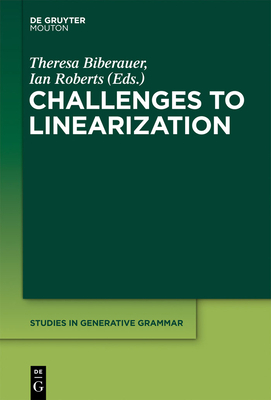
Challenges to Linearization

local_shippingShip to Me
In Stock.
FREE Shipping for Club Members help

Overview

The ten contributions in this volume focus on a range of linearization challenges, all of which aim to shed new light on the central, still largely mysterious question of how the abundant evidence that linguistic structures are hierarchically organised can plausibly be reconciled with the fact that actually realised linguistic strings are typically sequentially ordered. Some of the contributions present particularly challenging data, those on the mixed spoken and signed output of bimodal Italian children, Quechua nominal morphology, Kannada reduplication and Taqbaylit of Chemini "floating prepositions" all being cases in point. Others have a typological focus, highlighting and attempting to explain striking patterns like the Final-over-Final Constraint or considering the predictions of particular theoretical approacesh (the movement theory of Control, multidominance, Distributed Morphology) in relation to structures that we do and don't expect to be "possible linguistic structures". Broader architectural questions also receive attention from various perspectives.

This volume will be of interest to advanced students and researchers with interests in the externalisation of ling

This item is Non-Returnable

Details

  • ISBN-13: 9781614513100
  • ISBN-10: 1614513104
  • Publisher: de Gruyter Mouton
  • Publish Date: March 2013
  • Dimensions: 9.21 x 6.14 x 0.88 inches
  • Shipping Weight: 1.58 pounds
  • Page Count: 385

Related Categories

You May Also Like...

    1

BAM Customer Reviews