menu
{ "item_title" : "Coloniality in the Cliff Swallow", "item_author" : [" Charles R. Brown", "Mary Bomberger Brown "], "item_description" : "Many animal species live and breed in colonies. Although biologists have documented numerous costs and benefits of group living, such as increased competition for limited resources and more pairs of eyes to watch for predators, they often still do not agree on why coloniality evolved in the first place.Drawing on their twelve-year study of a population of cliff swallows in Nebraska, the Browns investigate twenty-six social and ecological costs and benefits of coloniality, many never before addressed in a systematic way for any species. They explore how these costs and benefits are reflected in reproductive success and survivorship, and speculate on the evolution of cliff swallow coloniality.This work, the most comprehensive and detailed study of vertebrate coloniality to date, will be of interest to all who study social animals, including behavioral ecologists, population biologists, ornithologists, and parasitologists. Its focus on the evolution of coloniality will also appeal to evolutionary biologists and to psychologists studying decision making in animals.", "item_img_path" : "https://covers4.booksamillion.com/covers/bam/0/22/607/626/0226076261_b.jpg", "price_data" : { "retail_price" : "68.00", "online_price" : "68.00", "our_price" : "68.00", "club_price" : "68.00", "savings_pct" : "0", "savings_amt" : "0.00", "club_savings_pct" : "0", "club_savings_amt" : "0.00", "discount_pct" : "10", "store_price" : "" } }
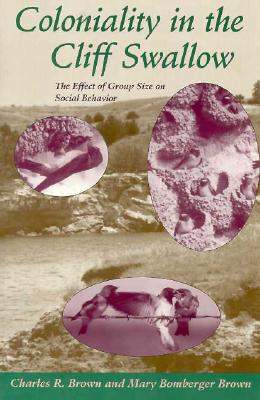
Coloniality in the Cliff Swallow|Charles R. Brown

Coloniality in the Cliff Swallow : The Effect of Group Size on Social Behavior

local_shippingShip to Me
On Order. Usually ships in 2-4 weeks
FREE Shipping for Club Members help

Overview

Many animal species live and breed in colonies. Although biologists have documented numerous costs and benefits of group living, such as increased competition for limited resources and more pairs of eyes to watch for predators, they often still do not agree on why coloniality evolved in the first place.Drawing on their twelve-year study of a population of cliff swallows in Nebraska, the Browns investigate twenty-six social and ecological costs and benefits of coloniality, many never before addressed in a systematic way for any species. They explore how these costs and benefits are reflected in reproductive success and survivorship, and speculate on the evolution of cliff swallow coloniality.This work, the most comprehensive and detailed study of vertebrate coloniality to date, will be of interest to all who study social animals, including behavioral ecologists, population biologists, ornithologists, and parasitologists. Its focus on the evolution of coloniality will also appeal to evolutionary biologists and to psychologists studying decision making in animals.

This item is Non-Returnable

Details

  • ISBN-13: 9780226076263
  • ISBN-10: 0226076261
  • Publisher: University of Chicago Press
  • Publish Date: July 1996
  • Dimensions: 9.05 x 6.11 x 1.08 inches
  • Shipping Weight: 1.74 pounds
  • Page Count: 580

Related Categories

You May Also Like...

    1

BAM Customer Reviews