menu
{ "item_title" : "Decentralization as a Precondition for Local Development", "item_author" : [" Taino J. Monteiro "], "item_description" : "Decentralization has been promoted as a pathway to effective governance and local development, yet in Guinea-Bissau the legal framework established for it has remained unimplemented for more than twenty-nine years. This book argues that meaningful local development cannot occur without empowered municipal governments and examines why decentralization has repeatedly stalled. It traces the historical roots of centralization from Amilcar Cabral 's development vision through the PAIGC single-party regimes (1974-1994) to the democratic era, showing how power and resources remained concentrated in Bissau while rural populations were marginalized. It also assesses recent efforts supported by the United Nations Development Programme (UNDP), particularly the creation of participatory planning institutions (IPCCs) in Cacheu and Gabu regions, as preliminary steps toward reform. The analysis identifies persistent obstacles-politicization of public administration, fiscal centralization, and weak institutional capacity-compounded by elite resistance.", "item_img_path" : "https://covers2.booksamillion.com/covers/bam/6/40/000/001/6400000011_b.jpg", "price_data" : { "retail_price" : "50.92", "online_price" : "50.92", "our_price" : "50.92", "club_price" : "50.92", "savings_pct" : "0", "savings_amt" : "0.00", "club_savings_pct" : "0", "club_savings_amt" : "0.00", "discount_pct" : "10", "store_price" : "" } }
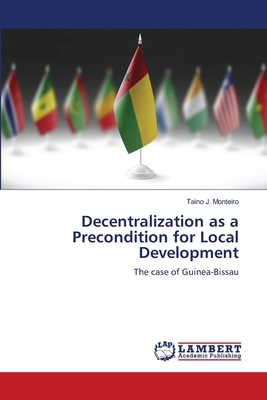
Decentralization as a Precondition for Local Development|Taino J. Monteiro

Decentralization as a Precondition for Local Development

local_shippingShip to Me
In Stock.
FREE Shipping for Club Members help

Overview

Decentralization has been promoted as a pathway to effective governance and local development, yet in Guinea-Bissau the legal framework established for it has remained unimplemented for more than twenty-nine years. This book argues that meaningful local development cannot occur without empowered municipal governments and examines why decentralization has repeatedly stalled. It traces the historical roots of centralization from Amilcar Cabral 's development vision through the PAIGC single-party regimes (1974-1994) to the democratic era, showing how power and resources remained concentrated in Bissau while rural populations were marginalized. It also assesses recent efforts supported by the United Nations Development Programme (UNDP), particularly the creation of participatory planning institutions (IPCCs) in Cacheu and Gabu regions, as preliminary steps toward reform. The analysis identifies persistent obstacles-politicization of public administration, fiscal centralization, and weak institutional capacity-compounded by elite resistance.

This item is Non-Returnable

Details

  • ISBN-13: 9786400000017
  • ISBN-10: 6400000011
  • Publisher: LAP Lambert Academic Publishing
  • Publish Date: February 2026
  • Dimensions: 9 x 6 x 0.13 inches
  • Shipping Weight: 0.19 pounds
  • Page Count: 56

Related Categories

You May Also Like...

    1

BAM Customer Reviews