menu
{ "item_title" : "Examining Core Elements of International Research Collaboration", "item_author" : [" Institute of Medicine", "National Academy of Engineering", "National Academy of Sciences "], "item_description" : "The globalization of science, engineering, and medical research is proceeding rapidly. The globalization of research has important implications for the U.S. research enterprise, for the U.S. government agencies, academic institutions, and companies that support and perform research, and for the world at large. As science and technology capabilities grow around the world, U.S.-based organizations are finding that international collaborations and partnerships provide unique opportunities to enhance research and training. At the same time, significant obstacles exist to smooth collaboration across national borders. Enhancing international collaboration requires recognition of differences in culture, legitimate national security needs, and critical needs in education and training. In response to these trends, the Government-University-Industry Research Roundtable (GUIRR) launched a Working Group on International Research Collaborations (I-Group) in 2008, following its meeting on New Partnerships on a Global Platform that June. As part of I-Group's continuing effort, a workshop on Examining Core Elements of International Research Collaboration was held July 26-27, 2010 in Washington, DC. One primary goal of the workshop is to better understand the risks involved in international research collaboration for organizations and individual participants, and the mechanisms that can be used to manage those risks. Issues to be addressed in the workshop include the following: (1) Cultural Differences and Nuances; (2) Legal Issues and Agreements; (3) Differences in Ethical Standards; (4) Research Integrity and the Responsible Conduct of Research; (5) Intellectual Property; (6) Risk Management; (7) Export Controls; and (8) Strategies for Developing Meaningful International Collaborations. The goal for the workshop and the summary, Examining Core Elements of International Research Collaboration, is to serve as an information resource for participants and others interested in international research collaborations. It will also aid I-Group in setting its future goals and priorities.", "item_img_path" : "https://covers2.booksamillion.com/covers/bam/0/30/921/640/0309216400_b.jpg", "price_data" : { "retail_price" : "37.00", "online_price" : "37.00", "our_price" : "37.00", "club_price" : "37.00", "savings_pct" : "0", "savings_amt" : "0.00", "club_savings_pct" : "0", "club_savings_amt" : "0.00", "discount_pct" : "10", "store_price" : "" } }
Examining Core Elements of International Research Collaboration|Institute of Medicine

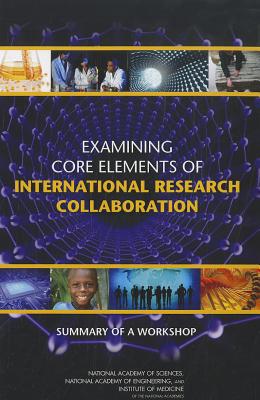
Examining Core Elements of International Research Collaboration : Summary of a Workshop

local_shippingShip to Me
In Stock.
FREE Shipping for Club Members help

Overview

The globalization of science, engineering, and medical research is proceeding rapidly. The globalization of research has important implications for the U.S. research enterprise, for the U.S. government agencies, academic institutions, and companies that support and perform research, and for the world at large. As science and technology capabilities grow around the world, U.S.-based organizations are finding that international collaborations and partnerships provide unique opportunities to enhance research and training. At the same time, significant obstacles exist to smooth collaboration across national borders. Enhancing international collaboration requires recognition of differences in culture, legitimate national security needs, and critical needs in education and training.

In response to these trends, the Government-University-Industry Research Roundtable (GUIRR) launched a Working Group on International Research Collaborations (I-Group) in 2008, following its meeting on New Partnerships on a Global Platform that June. As part of I-Group's continuing effort, a workshop on Examining Core Elements of International Research Collaboration was held July 26-27, 2010 in Washington, DC. One primary goal of the workshop is to better understand the risks involved in international research collaboration for organizations and individual participants, and the mechanisms that can be used to manage those risks. Issues to be addressed in the workshop include the following: (1) Cultural Differences and Nuances; (2) Legal Issues and Agreements; (3) Differences in Ethical Standards; (4) Research Integrity and the Responsible Conduct of Research; (5) Intellectual Property; (6) Risk Management; (7) Export Controls; and (8) Strategies for Developing Meaningful International Collaborations.

The goal for the workshop and the summary, Examining Core Elements of International Research Collaboration, is to serve as an information resource for participants and others interested in international research collaborations. It will also aid I-Group in setting its future goals and priorities.

This item is Non-Returnable

Details

  • ISBN-13: 9780309216401
  • ISBN-10: 0309216400
  • Publisher: National Academies Press
  • Publish Date: October 2011
  • Dimensions: 8.9 x 6 x 0.4 inches
  • Shipping Weight: 0.5 pounds
  • Page Count: 128

Related Categories

You May Also Like...

    1

BAM Customer Reviews