menu
{ "item_title" : "HPLC", "item_author" : [" Roger M. Smith", "Toshihiko T. Hanai "], "item_description" : "How can these compounds be separated? Why was that method used? These are the two basic questions often asked by students of chromatography. HPLC: A Practical Guide provides the answers, enabling the reader to grasp the concepts of the technique using simple, representative chromatograms. Divided into six chapters, this practical guide covers basic concepts of HPLC; instrumentation; stationary phase materials; eluents; column efficiency; and the influence of physical chemistry on separations. Focusing on the basic considerations such as selection of stationary phase and eluent, rather than specific applications, sections on troubleshooting are also included. Uniquely, the descriptions of chromatographic separations are based on solubility using molecular properties, and solubility parameters are used to analyse the selections of chromatographic mode and column. Presenting the chemistry of liquid chromatography for undergraduate students, this valuable practical guide will also be useful for laboratory staff in industry and academia.", "item_img_path" : "https://covers3.booksamillion.com/covers/bam/0/85/404/515/0854045155_b.jpg", "price_data" : { "retail_price" : "84.00", "online_price" : "84.00", "our_price" : "84.00", "club_price" : "84.00", "savings_pct" : "0", "savings_amt" : "0.00", "club_savings_pct" : "0", "club_savings_amt" : "0.00", "discount_pct" : "10", "store_price" : "" } }
HPLC|Roger M. Smith

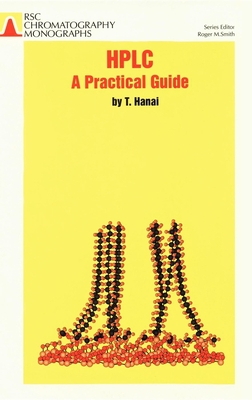
HPLC : A Practical Guide

local_shippingShip to Me
In Stock.
FREE Shipping for Club Members help

Overview

How can these compounds be separated? Why was that method used? These are the two basic questions often asked by students of chromatography. HPLC: A Practical Guide provides the answers, enabling the reader to grasp the concepts of the technique using simple, representative chromatograms. Divided into six chapters, this practical guide covers basic concepts of HPLC; instrumentation; stationary phase materials; eluents; column efficiency; and the influence of physical chemistry on separations. Focusing on the basic considerations such as selection of stationary phase and eluent, rather than specific applications, sections on troubleshooting are also included. Uniquely, the descriptions of chromatographic separations are based on solubility using molecular properties, and solubility parameters are used to analyse the selections of chromatographic mode and column. Presenting the chemistry of liquid chromatography for undergraduate students, this valuable practical guide will also be useful for laboratory staff in industry and academia.

This item is Non-Returnable

Details

  • ISBN-13: 9780854045150
  • ISBN-10: 0854045155
  • Publisher: Royal Society of Chemistry
  • Publish Date: September 1999
  • Dimensions: 9.46 x 6.32 x 0.52 inches
  • Shipping Weight: 0.76 pounds
  • Page Count: 144

Related Categories

You May Also Like...

    1

BAM Customer Reviews