menu
{ "item_title" : "The Idea of Form", "item_author" : [" Rodolphe Gasche "], "item_description" : "Against the assumption that aesthetic form relates to a harmonious arrangement of parts into a beautiful whole, this book argues that reason is the real theme of the Critique of Judgment as of the two earlier Critiques. Since aesthetic judgment of the beautiful becomes possible only when the mind is confronted with things of nature, for which no determined concepts of understanding are available, aesthetic judgment is involved in an epistemological or, rather, para-epistemological task. The predicate beautiful indicates that something has minimal form and is cognizable. This book explores this concept of form, in particular the role of presentation (Darstellung) in what Kant refers to as mere form, which involves not only the understanding, but also reason as the faculty of ideas. Such a notion of form reveals why the beautiful can be related to the morally good. On the basis of this reinterpreted concept of form, most major concepts and themes of the Critique of Judgment-such as disinterestedness, free play, the sublime, genius, and beautiful arts-are examined by the author and shown in a new light.", "item_img_path" : "https://covers1.booksamillion.com/covers/bam/0/80/474/621/0804746214_b.jpg", "price_data" : { "retail_price" : "35.00", "online_price" : "35.00", "our_price" : "35.00", "club_price" : "35.00", "savings_pct" : "0", "savings_amt" : "0.00", "club_savings_pct" : "0", "club_savings_amt" : "0.00", "discount_pct" : "10", "store_price" : "" } }
The Idea of Form|Rodolphe Gasche

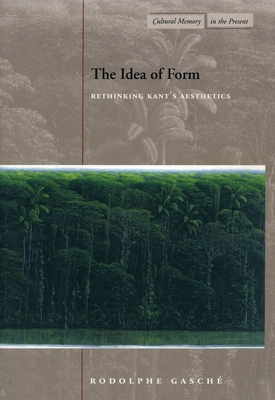
The Idea of Form : Rethinking Kant's Aesthetics

local_shippingShip to Me
In Stock.
FREE Shipping for Club Members help

Overview

Against the assumption that aesthetic form relates to a harmonious arrangement of parts into a beautiful whole, this book argues that reason is the real theme of the Critique of Judgment as of the two earlier Critiques. Since aesthetic judgment of the beautiful becomes possible only when the mind is confronted with things of nature, for which no determined concepts of understanding are available, aesthetic judgment is involved in an epistemological or, rather, para-epistemological task. The predicate "beautiful" indicates that something has minimal form and is cognizable. This book explores this concept of form, in particular the role of presentation (Darstellung) in what Kant refers to as "mere form," which involves not only the understanding, but also reason as the faculty of ideas. Such a notion of form reveals why the beautiful can be related to the morally good. On the basis of this reinterpreted concept of form, most major concepts and themes of the Critique of Judgment-such as disinterestedness, free play, the sublime, genius, and beautiful arts-are examined by the author and shown in a new light.

This item is Non-Returnable

Details

  • ISBN-13: 9780804746212
  • ISBN-10: 0804746214
  • Publisher: Stanford University Press
  • Publish Date: December 2002
  • Dimensions: 9.02 x 7.68 x 0.6 inches
  • Shipping Weight: 0.81 pounds
  • Page Count: 272

Related Categories

You May Also Like...

    1

BAM Customer Reviews