 Ask Bookie

Overview
Almost everyone who argues about this has never stood in the place it happened.
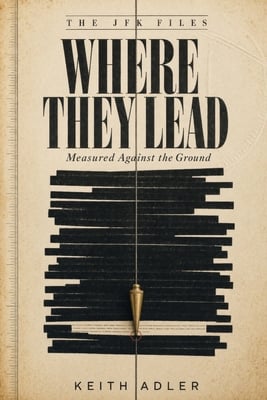
Keith Adler rebuilt Dealey Plaza to survey accuracy. Every distance in this book traces back to one document: a fourteen-row tabulation made by surveyors who walked that street in 1964 and wrote down exactly where the President's car was at fourteen frames of the Zapruder film. Everything else, the range, the angle, the fall of Elm Street, what the oak tree covered, is arithmetic performed on those fourteen rows, and the arithmetic is shown so you can check it.
What comes out is not a theory. It is a set of measurements that quietly rule some arguments out and quietly make others harder to dismiss.
Every claim in this book is labeled. Established, meaning the record supports it and serious people on all sides accept it. Disputed, meaning good people read the same evidence and disagree. Theory, meaning somebody proposed it and the evidence does not carry it. Reconstruction, meaning it is the author's own arithmetic rather than somebody's testimony. The labels appear in the margin as you read, so you always know what you are being handed.
And then there are the files. Between March 2025 and January 2026 the National Archives released more than ninety-four thousand pages in six separate drops. They arrived as scanned photographs of paper, technically public and practically unsearchable. Adler turned the collection into text and read it for the machinery rather than the story: the routing stamps, the classification boxes, the notations that decide whether a page can ever be found again.
What that produced includes a Bureau cable naming a source whose identity is not hard to work out, a Top Secret intercept sent to two foreign capitals through a unit built for exactly that, and a count of the documents deliberately kept out of the central index. One agency did it by hand. The other had a box printed on the form.
It also produced a correction to the 1964 survey itself. Two rows of that tabulation are impossible. They put the limousine nearly stationary for a quarter of a second. Adler tested them, found the measurements were sound, and identified what was actually wrong: a frame number that has been sitting in the published record for sixty-two years.
The argument the book ends on is not about a gunman. It is about a single word in the law that opened these archives, and about four allied governments that have never once been asked what they hold.
And then he tells you what he thinks. Not a gunman on a grassy knoll. He sets it out in a single paragraph you can disagree with immediately: who could not have done this and why, why the arrest in that movie theater does not read like luck, and why he no longer believes the payday was Vietnam. What he has come round to is smaller and worse. He thinks it was personal, and that the man it was personal about may not be the one everybody assumes.
One question he leaves open, because he cannot close it. He does not pretend the two answers are equally weighted.
For readers of Gerald Posner, Vincent Bugliosi, David Talbot and Jefferson Morley, and for anyone who has grown tired of being told a story instead of being shown the ground.
This item is Non-Returnable
Customers Also Bought


Details
- ISBN-13: 9798190823561
- ISBN-10: 9798190823561
- Publisher: Independently Published
- Publish Date: August 2026
- Dimensions: 9 x 6 x 0.8 inches
- Shipping Weight: 1.15 pounds
- Page Count: 390
Related Categories
You May Also Like...
- 1







