menu
{ "item_title" : "Perceiving-Thinking-Writing", "item_author" : [" Donald Wesling "], "item_description" : "Donald Wesling's leading argument, drawn from a crossover theory of the humanities, has philosophy and literature in a relation of constructive interference. What is common to both disciplines is the attempt to understand the necessary but often forgotten act of perceiving within the embodied mind. Wesling asks and answers: How does perceptual content enter thinking and writing?His topics include a redefinition of Maurice Merleau-Ponty's phenomenology as a big-hearted rationality; quantum interference as a metaphor for thinking and also for the relation of self to the outer surround of things and persons; nine key terms from Merleau-Ponty as applied to the practical reading of poems and stories; the role of the sentence as an energy that structures thinking and writing; ordinary creativity and co-creativity.Overall, Wesling emphasizes that the meaning for the humanities, now, may be found in Merleau-Ponty's belief that future work will be a search for a secondary, laborious, rediscovered na vet and that in this pursuit our relation to what is true must pass through others. ABSTRACTING & INDEXING Baidu ScholarBayerische StaatsbibliothekBDSBoDBowker Book DataCiandoCNKI Scholar (China National Knowledge Infrastructure)DimensionsEBSCOExLibrisGoogle BooksGoogle ScholarNavigaReadCubeSemantic Scholar TDOne (TDNet)WorldCat (OCLC)X-MOL ", "item_img_path" : "https://covers3.booksamillion.com/covers/bam/8/36/740/596/836740596X_b.jpg", "price_data" : { "retail_price" : "38.99", "online_price" : "38.99", "our_price" : "38.99", "club_price" : "38.99", "savings_pct" : "0", "savings_amt" : "0.00", "club_savings_pct" : "0", "club_savings_amt" : "0.00", "discount_pct" : "10", "store_price" : "" } }
Perceiving-Thinking-Writing|Donald Wesling

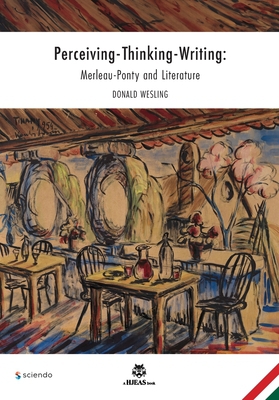
Perceiving-Thinking-Writing : Merleau-Ponty and Literature

local_shippingShip to Me
In Stock.
FREE Shipping for Club Members help

Overview

Donald Wesling's leading argument, drawn from a crossover theory of the humanities, has philosophy and literature in a relation of constructive interference. What is common to both disciplines is the attempt to understand the necessary but often forgotten act of perceiving within the embodied mind. Wesling asks and answers: How does perceptual content enter thinking and writing?
His topics include a redefinition of Maurice Merleau-Ponty's phenomenology as a big-hearted rationality; quantum interference as a metaphor for thinking and also for the relation of self to the outer surround of things and persons; nine key terms from Merleau-Ponty as applied to the practical reading of poems and stories; the role of the sentence as an energy that structures thinking and writing; ordinary creativity and co-creativity.
Overall, Wesling emphasizes that the meaning for the humanities, now, may be found in Merleau-Ponty's belief that future work will be a search for "a secondary, laborious, rediscovered na vet " and that in this pursuit "our relation to what is true must pass through others."

ABSTRACTING & INDEXING

Baidu Scholar
Bayerische Staatsbibliothek
BDS
BoD
Bowker Book Data
Ciando
CNKI Scholar (China National Knowledge Infrastructure)
Dimensions
EBSCO
ExLibris
Google Books
Google Scholar
Naviga
ReadCube
Semantic Scholar
TDOne (TDNet)
WorldCat (OCLC)
X-MOL

This item is Non-Returnable

Details

  • ISBN-13: 9788367405966
  • ISBN-10: 836740596X
  • Publisher: Sciendo
  • Publish Date: May 2025
  • Dimensions: 9.61 x 6.69 x 0.42 inches
  • Shipping Weight: 0.71 pounds
  • Page Count: 198

Related Categories

You May Also Like...

    1

BAM Customer Reviews

