menu
{ "item_title" : "Specifying Statistical Models", "item_author" : [" J. P. Florens", "M. Mouchart", "J. P. Raoult "], "item_description" : "During the last decades. the evolution of theoretical statistics has been marked by a considerable expansion of the number of mathematically and computationaly trac- table models. Faced with this inflation. applied statisticians feel more and more un- comfortable: they are often hesitant about their traditional (typically parametric) assumptions. such as normal and i. i. d . - ARMA forms for time-series. etc . - but are at the same time afraid of venturing into the jungle of less familiar models. The prob- lem of the justification for taking up one model rather than another one is thus a crucial one. and can take different forms. (a)ifi iQ: Do observations suggest the use of a different model from the one initially proposed (e. g. one which takes account of outliers). or do they render plau- sible a choice from among different proposed models (e. g. fixing or not the value of a certai n parameter) ? (b) tlQ L l rQ1 iIMHQ: How is it possible to compute a distance between a given model and a less (or more) sophisticated one. and what is the technical meaning of such a distance ? (c) BQe: To what extent do the qualities of a procedure. well adapted to a small model. deteriorate when this model is replaced by a more general one? This question can be considered not only. as usual. in a parametric framework (contamina- tion) or in the extension from parametriC to non parametric models but also.", "item_img_path" : "https://covers3.booksamillion.com/covers/bam/0/38/790/809/0387908099_b.jpg", "price_data" : { "retail_price" : "54.99", "online_price" : "54.99", "our_price" : "54.99", "club_price" : "54.99", "savings_pct" : "0", "savings_amt" : "0.00", "club_savings_pct" : "0", "club_savings_amt" : "0.00", "discount_pct" : "10", "store_price" : "" } }
Specifying Statistical Models|J. P. Florens

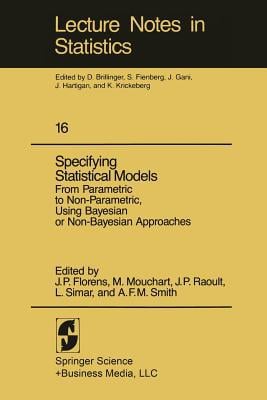
Specifying Statistical Models : From Parametric to Non-Parametric, Using Bayesian or Non-Bayesian Approaches

local_shippingShip to Me
In Stock.
FREE Shipping for Club Members help

Overview

During the last decades. the evolution of theoretical statistics has been marked by a considerable expansion of the number of mathematically and computationaly trac- table models. Faced with this inflation. applied statisticians feel more and more un- comfortable: they are often hesitant about their traditional (typically parametric) assumptions. such as normal and i. i. d . - ARMA forms for time-series. etc . - but are at the same time afraid of venturing into the jungle of less familiar models. The prob- lem of the justification for taking up one model rather than another one is thus a crucial one. and can take different forms. (a) ifi iQ: Do observations suggest the use of a different model from the one initially proposed (e. g. one which takes account of outliers). or do they render plau- sible a choice from among different proposed models (e. g. fixing or not the value of a certai n parameter) ? (b) tlQ L l rQ1 iIMHQ: How is it possible to compute a "distance" between a given model and a less (or more) sophisticated one. and what is the technical meaning of such a "distance" ? (c) BQe: To what extent do the qualities of a procedure. well adapted to a "small" model. deteriorate when this model is replaced by a more general one? This question can be considered not only. as usual. in a parametric framework (contamina- tion) or in the extension from parametriC to non parametric models but also.

This item is Non-Returnable

Details

  • ISBN-13: 9780387908090
  • ISBN-10: 0387908099
  • Publisher: Springer
  • Publish Date: January 1983
  • Dimensions: 9.21 x 6.14 x 0.46 inches
  • Shipping Weight: 0.69 pounds
  • Page Count: 204

Related Categories

You May Also Like...

    1

BAM Customer Reviews