menu
{ "item_title" : "Terrorism, Risk and the City", "item_author" : [" Jon Coaffee "], "item_description" : "The development of defensive strategies encompassing the fortification and privatization of the city has attracted significant attention during recent years, and has become particularly relevant in the aftermath of September 11th. Dealing with issues of risk, security and the spatial restructuring of contemporary western cities, this book examines how the perceived risk of terrorist attack led to changes in the physical form and institutional infrastructure of the city of London during the 1990s when the city was a prime terrorist target. The book analyses how the various formal and informal strategies adopted in the City attempted to reduce both the physical and financial risk of terrorism. This was undertaken through a series of place-specific security initiatives and risk management policies which led to increased fortification, a substantial rise in terrorism insurance premiums, and, changing institutional relations at a variety of spatial scales. It also argues that the security measures deployed were developed not in terms of an anti-terrorist effort, but in relation to the unintended by-products of these approaches such as crime reduction and enhanced traffic management capabilities.", "item_img_path" : "https://covers3.booksamillion.com/covers/bam/0/75/463/555/0754635554_b.jpg", "price_data" : { "retail_price" : "200.00", "online_price" : "200.00", "our_price" : "200.00", "club_price" : "200.00", "savings_pct" : "0", "savings_amt" : "0.00", "club_savings_pct" : "0", "club_savings_amt" : "0.00", "discount_pct" : "10", "store_price" : "" } }
Terrorism, Risk and the City|Jon Coaffee

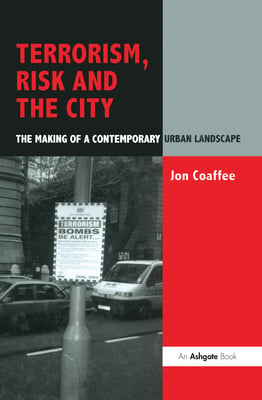
Terrorism, Risk and the City : The Making of a Contemporary Urban Landscape

local_shippingShip to Me
On Order. Usually ships in 2-4 weeks
FREE Shipping for Club Members help

Overview

The development of defensive strategies encompassing the fortification and privatization of the city has attracted significant attention during recent years, and has become particularly relevant in the aftermath of September 11th. Dealing with issues of risk, security and the spatial restructuring of contemporary western cities, this book examines how the perceived risk of terrorist attack led to changes in the physical form and institutional infrastructure of the city of London during the 1990s when the city was a prime terrorist target. The book analyses how the various formal and informal strategies adopted in the City attempted to reduce both the physical and financial risk of terrorism. This was undertaken through a series of place-specific security initiatives and risk management policies which led to increased fortification, a substantial rise in terrorism insurance premiums, and, changing institutional relations at a variety of spatial scales. It also argues that the security measures deployed were developed not in terms of an anti-terrorist effort, but in relation to the unintended by-products of these approaches such as crime reduction and enhanced traffic management capabilities.

This item is Non-Returnable

Details

  • ISBN-13: 9780754635550
  • ISBN-10: 0754635554
  • Publisher: Routledge
  • Publish Date: November 2003
  • Dimensions: 6.1 x 8.82 x 0.75 inches
  • Shipping Weight: 1.15 pounds
  • Page Count: 282

Related Categories

You May Also Like...

    1

BAM Customer Reviews