menu
{ "item_title" : "The Theory of the Imaginary in Geometry", "item_author" : [" Hatton", "John Leigh Smeathman Hatton "], "item_description" : "John Leigh Smeathman Hatton (1865-1933) was a British mathematician and educator. He worked for 40 years at a pioneering educational project in East London that began as the People's Palace and eventually became Queen Mary College in the University of London. Hatton served as its Principal from 1908 to 1933. This book, published in 1920, explores the relationship between imaginary and real non-Euclidean geometry through graphical representations of imaginaries under a variety of conventions. This relationship is of importance as points with complex determining elements are present in both imaginary and real geometry. Hatton uses concepts including the use of co-ordinate methods to develop and illustrate this relationship, and concentrates on the idea that the only differences between real and imaginary points exist solely in relation to other points. This clearly written volume exemplifies the type of non-Euclidean geometry research current at the time of publication.", "item_img_path" : "https://covers2.booksamillion.com/covers/bam/1/10/801/310/1108013104_b.jpg", "price_data" : { "retail_price" : "42.00", "online_price" : "42.00", "our_price" : "42.00", "club_price" : "42.00", "savings_pct" : "0", "savings_amt" : "0.00", "club_savings_pct" : "0", "club_savings_amt" : "0.00", "discount_pct" : "10", "store_price" : "" } }
The Theory of the Imaginary in Geometry|Hatton

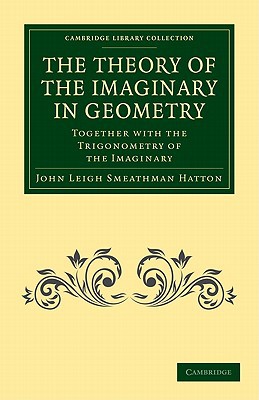
The Theory of the Imaginary in Geometry : Together with the Trigonometry of the Imaginary

local_shippingShip to Me
In Stock.
FREE Shipping for Club Members help

Overview

John Leigh Smeathman Hatton (1865-1933) was a British mathematician and educator. He worked for 40 years at a pioneering educational project in East London that began as the People's Palace and eventually became Queen Mary College in the University of London. Hatton served as its Principal from 1908 to 1933. This book, published in 1920, explores the relationship between imaginary and real non-Euclidean geometry through graphical representations of imaginaries under a variety of conventions. This relationship is of importance as points with complex determining elements are present in both imaginary and real geometry. Hatton uses concepts including the use of co-ordinate methods to develop and illustrate this relationship, and concentrates on the idea that the only differences between real and imaginary points exist solely in relation to other points. This clearly written volume exemplifies the type of non-Euclidean geometry research current at the time of publication.

This item is Non-Returnable

Details

  • ISBN-13: 9781108013109
  • ISBN-10: 1108013104
  • Publisher: Cambridge University Press
  • Publish Date: September 2010
  • Dimensions: 8.5 x 5.5 x 0.52 inches
  • Shipping Weight: 0.65 pounds
  • Page Count: 230

Related Categories

You May Also Like...

    1

BAM Customer Reviews