menu
{ "item_title" : "The Transactioneer", "item_author" : [" Alice Marples "], "item_description" : "The history of how transactions built Britain's empire of public science.Hans Sloane is often remembered as the founding collector of the British Museum. In The Transactioneer, Alice Marples offers a different portrait: not a heroic architect of Enlightenment progress, but a skilled manager of transactions--of specimens, correspondence, credit, and trust--whose practices helped redefine how natural knowledge was made public in eighteenth-century Britain. The book examines how this knowledge was amassed and managed at the turn of the eighteenth century, tracing the daily labor of collecting, storing, cross-referencing, classifying, and circulating information through paper technologies and material exchange. Rather than treating Sloane as exceptional, Marples uses him as a lens through which to reconstruct a broader culture of knowledge-making that moved between private homes, coffeehouses, medical marketplaces, trading networks, and the Royal Society. Sloane's networks extended from Scottish cartographers and Irish landowners to Caribbean plantations and global trading circuits. These exchanges were embedded in systems of empire and slavery, whose violence and exclusions shaped both the materials collected and the authority claimed in their name. Satirized in 1700 as The Transactioneer for his reliance on correspondents and appetite for accumulation, Sloane nonetheless helped align natural history with commercial practice and a rhetoric of the public good that served to justify institutional power. By reconstructing the material and moral economies that sustained early modern collecting, Marples reveals how trust, credit, and exchange underpinned the rise of public science--and how the management of knowledge became inseparable from the management of empire.", "item_img_path" : "https://covers1.booksamillion.com/covers/bam/1/42/145/607/1421456079_b.jpg", "price_data" : { "retail_price" : "54.95", "online_price" : "54.95", "our_price" : "54.95", "club_price" : "54.95", "savings_pct" : "0", "savings_amt" : "0.00", "club_savings_pct" : "0", "club_savings_amt" : "0.00", "discount_pct" : "10", "store_price" : "" } }
The Transactioneer|Alice Marples

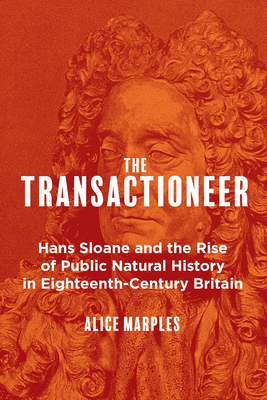
The Transactioneer : Hans Sloane and the Rise of Public Natural History in Eighteenth-Century Britain

PRE-ORDER NOW:
local_shippingShip to Me
Preorder. This item will be available on December 8, 2026 .
FREE Shipping for Club Members help

Overview

The history of how transactions built Britain's empire of public science.

Hans Sloane is often remembered as the founding collector of the British Museum. In The Transactioneer, Alice Marples offers a different portrait: not a heroic architect of Enlightenment progress, but a skilled manager of transactions--of specimens, correspondence, credit, and trust--whose practices helped redefine how natural knowledge was made public in eighteenth-century Britain.

The book examines how this knowledge was amassed and managed at the turn of the eighteenth century, tracing the daily labor of collecting, storing, cross-referencing, classifying, and circulating information through paper technologies and material exchange. Rather than treating Sloane as exceptional, Marples uses him as a lens through which to reconstruct a broader culture of knowledge-making that moved between private homes, coffeehouses, medical marketplaces, trading networks, and the Royal Society. Sloane's networks extended from Scottish cartographers and Irish landowners to Caribbean plantations and global trading circuits. These exchanges were embedded in systems of empire and slavery, whose violence and exclusions shaped both the materials collected and the authority claimed in their name. Satirized in 1700 as "The Transactioneer" for his reliance on correspondents and appetite for accumulation, Sloane nonetheless helped align natural history with commercial practice and a rhetoric of the "public good" that served to justify institutional power.

By reconstructing the material and moral economies that sustained early modern collecting, Marples reveals how trust, credit, and exchange underpinned the rise of public science--and how the management of knowledge became inseparable from the management of empire.

This item is Non-Returnable

Details

  • ISBN-13: 9781421456072
  • ISBN-10: 1421456079
  • Publisher: Johns Hopkins University Press
  • Publish Date: December 2026
  • Dimensions: 9 x 6 x 0.59 inches
  • Page Count: 328

Related Categories

You May Also Like...

    1

BAM Customer Reviews